Tuesday, March 20, 2012

So, You Want to Eat a Beaver


By: Duane Fronek

So, you want to eat a beaver (Castor Canadensis). I’m asked many times if I eat the animals I trap and the answer is occasionally I do. And one of the things I get asked is do I eat the beaver I trap and yes I do. As a matter of fact it was pretty much the only meat I ate in the winter of 2008, I had just went thru a separation and money was tight as it is at times with these sorta things and was trapping to make a living. And beaver meat is high in protein and probably better than beef and supplemented well, well except for a good ribeye. So, where do ya start, well first you have to find one. Beaver are pretty much located throughout N. America. Most are trapped and some are shot depending on your state regulations. It’s really not hard to find one or you may know a trapper or a landowner that may have them in a pond or river etc. I prefer to eat a fresh beaver for the reason that when trapped they are not bled out. If it’s trapped I would go 2 days max to have good tasting meat. We’ll take care of the blood shortly.
Taking care of a beaver you’re planning to eat is important as it is with most game, to ensure the quality of the meat. Beaver are mainly caught in or near the water and are pretty much clean to begin with. Skinning them and the way you do it is important to have good tasting meat.
First lay the beaver on its back on a table or tailgate that’s clean, if it’s not clean layout a garbage bag to lay the beaver on. For your initial cuts I like to use a filet knife. I start out by sticking the knife in at the base of the tail with the sharp edge up and just below the skin, then run your knife up to the vent but stopping about an inch away and then run the knife around the vent till you’ve cut the hide all the way around the vent. It’s important to add that any juicy liquid coming out of the vent if any, needs to be dabbed off with paper towel so that any of that juice does not leak onto the meat. This stuff is oil from the castor gland and has an interesting odor, not a real bad odor just interesting but can ruin the flavor of the meat in an instant, Castor is used in cosmetics and at times goes for $50.00 a pound, but we’ll touch on that later. Once the vent is circled, run your knife straight up the center of the belly just under the skin, you don’t have to get into the thin layer between the hide and stomach. Continue all the way up to the chin until you come through the bottom lip. Next, make a cut through the skin at the base of the tail where the fur stops and the tail begins and cut all the way around the base. Basically ringing it. Once that’s done you need to next cut off the feet. The diagram shows where these cuts are. Start by cutting from the underside of the foot where the heel pad meets the fur and then cut all the way around the foot, once the foot is ringed cut deeper into the underside where you started, this will cut the tendons. Beaver have soft or weak joints by design that aid in swimming and once you make that cut you can grab the foot and twist it off, you might have to aid it with cutting to completely take it off, but it’s relatively easy.
Initial cuts
Front foot
Back foot


Once you have the feet off it’s time to start peeling the hide off. Now is the time to swap out the filet knife with a hunting knife, they seem to work best. The best ones I’ve found are the Buck(skinner) or the Shrade (sharp finger) both these knives have the right curve for skinning beaver, but whatever you have is fine, as long as it’s sharp. To start getting the hide, grab the hide about midway between the chin and vent. Note: the reason I call it a vent is because it’s similar to a birds, just one opening and all reproductive parts are inside, even males. Anyway, it doesn’t matter which side of the cut you grab. While grabbing the hide pull it away from the carcass and make a sweeping motion just under the hide going along the belly and ribs, keep working the knife this way while cutting and pulling the hide the whole length of the initial cut. Then do the same with the other side. Once you hit the legs it gets a little tricky, but once you figure it out it’ll be a snap.
Getting the leg through
Pulling the hide away


Pick any leg to start and pull the loose hide over the leg and feel for the leg. I usually grab the hide between the thumb and fore finger and use the other fingers to push against the leg from the fur side until the hide slips over the severed part of the leg bone. This will help push the leg up so you can run the knife along both sides of the leg and keep cutting along the leg until the hide is separate from the leg all the way around. Repeat this with each leg until your hide is basically laying flat and the beaver basically looks like it is just lying on the hide and the legs are out.

Now take the beaver by the head and base of tail and flip it over on its belly on a clean surface. Starting on whichever side you want, take and grasp the loose pelt like you did while skinning down the belly and just continue pulling and cutting along the beavers sides until you’re to the spine, then repeat the same on the other side the whole length of the pelt.


Once you’re to the spine, the hide should be separated from the carcass except for maybe the head. Just pull the pelt over the head and pull and cut as you have been until you cut through the ears, then onto the eyes and finally to and off the nose. Your pelt should be separated from the carcass at this time. 
Working it off the head


Fold the pelt in half skin to skin, then fold in half and again, fur to fur. I will usually then put the pelt in the freezer till another day when I have time to flesh them out or sell just the way they are. Beaver pelts are worth a few bucks if they’re taken in the fall and winter, and in early spring.

Now for the meat. There are only a couple things I take off the beaver for meat, which are the hind quarters and the backstraps. With the beaver still on its belly, take the filet knife and cut along the spine, then peel the meat back and keep cutting along the length of the back, staying close to the bone, working the backstraps off like you would on a deer. 
Cutting out the straps
A nice beaver backstrap

Once the straps are removed move to the hind quarters. Grab a hind quarter and move it around so you know where the hip joint is close to the spine and make a cut to the joint. Do this on both hinds. Now you can flip the beaver onto its back. You should be able to see or tell where the joint is from this side by now and cut into that joint and then all around. Now just bend the whole quarter back to pop and reveal the joint and finish severing the joint and hind quarter. 
Cutting off a hind quarter
Hind quarter off


Now that you have the hind quarters off that’s pretty much it, for the meat that is. Now just set the meat aside for a minute or two. You’ll notice if you look at the vent that behind it there is a gray mass on both sides, these are the castor glands and fur buyers buy these, basically take and cut away the membrane that holds them in place. But don’t cut into the gray, just the thin, basically clear membrane and gently work the castors out peeling it away from the membrane. When you’re close to getting it out you’ll notice they are joined together at the vent, just cut the vent off with the castor. It’ll kind of resemble rounded saddle bags.
Beaver Castor glands 


You can put them in a Ziploc and freeze fresh or hang them on a nail in a shed out of sunlight to dry as well.  If you get enough of them they’re worth saving, fur buyers pay by the pound.
With clean hands take the meat you just cut off and trim any fat that you can, then rinse under cold water washing whatever blood you can. Now take a large bowl and throw in a table spoon of salt and start filling with water to dissolve the salt, then add in the beaver meat. Once you have everything covered in the salt water put it into the fridge until the next day. The next day take and rinse the meat under cold water. Then proceed to cut the meat off the bone on the hind quarters and any fat that you missed the first time.

At this point there is a couple things you can do. You can freeze it in freezer bags for a later date or prepare it. If you’re going to prepare it you can do a couple things. One is you can chunk up the meat and throw it in a slow cooker until the meat just falls apart then just add your favorite barbeque ingredients and finish cooking. Or you can par boil it for about  20 minutes and drain. Then you can flour it with a mixture of salt and pepper or your favorite spices then pan fry. My favorite is to just chunk or cube it raw, then fry/sauté in butter and salt and pepper until done add in fried onions and mushrooms. Then add in fried potatoes and cover the whole thing in shredded Colby or Monterey jack cheese, cover with a lid under low heat until the cheese is melted and serve. Most people who have tried and ate the beaver I have cooked in these 2 ways said they could not tell the difference between beef or beaver and said the beaver actually tasted better. I sometimes grind the beaver into burger and they taste great. Anything you can do with beef, you can do with beaver, well except a good steak. Take a walk on the wild side and give it a try. Beaver, it's what's for Dinner.

PHOTOS taken by Duane Fronek or Renee Vitale.

Thursday, February 16, 2012

Coyotes, Keeping it Simple for Success

http://www.foremostcoyotehunting.com/2012/02/calling-keeping-it-simple-for-success.html
So what does it take to be successful at calling coyotes? Which call is the best? Which E-caller should I buy that’ll call em’ all in, what’s the best camo or rifle or decoy?
 Read more at Foremost Coyote......
http://www.foremostcoyotehunting.com/2012/02/calling-keeping-it-simple-for-success.html

Tuesday, January 17, 2012

Winter Time Coyote Hunt

The other day did some calling so I did a video story on the hunt. Its not long, but gives you an idea of the type of coyote hunting I do with the type of terrain and using it to my advantage, Northern WI style. I haven't blogged in a while because I've been trapping and calling coyotes, but when it dwindles down, I'll have more articles for you, its been an interesting season.
video

Friday, November 18, 2011

Some days ya just gotta go with the flow

Sometimes the trapline throws ya a curve ball. Well mine came today. Wasn't sure if I should just burn it and bury it, or try to pull it out. Well I didnt have enough matches so I opted for the latter. In the end everything worked out fine with a little brut persuasion.


And then help arrived

video
My partner standing in the hole.
But all's well ends well. Helped out on a cull hunt and got me a nice meat doe for the freezer,so all was not lost.
video
So, that was my day,it was alright though, I was in the outdoors like everyday and wouldn't trade it for the world, I belong out there. All in a days work chasing and killing coyotes.

Thursday, September 15, 2011

GRIM HUMOR

GRIM HUMOR


The headline in this morning’s Saint Paul paper reads, “80,000 ACRES AND GROWING – Smoke reaches Chicago as BWCA fire forces families from homes”.  For the non-canoeing public, BWCA stands for the Boundary Waters Canoe Wilderness that is protected from forest management; wildlife management; natural resource management and use; access roads (that would double as fire breaks and firefighting enablers); and other such human benefits such as downed timber (fire fuel) removal and use after storms by that federal ostrich behemoth the National Park Service.

The past two weeks I have read several reports about how the Bob Marshall Wilderness (that was, until recently, a very popular hunting destination for elk, deer, and moose) is now literally devoid of elk, deer, and moose as a result of federal introduction, protection, and spread of wolves and grizzly bears that have decimated the calves, fawns, and reproductive females of the elk, deer, and moose.  Thousands of these desirable and useful animals have been replaced by hundreds of deadly, dangerous, and destructive animals.  Also lost were 200-plus years of state and local Constitutional authority over what and how many wild animals would exist within each state and be allowed to coexist with local communities.  The Bob Marshall Wilderness (named after a “founder” of The Wilderness Society) encompasses over a Million Acres south of Glacier National Park in Montana and like the BWCA is “protected” from all manner of human prosperity by the National Forest Service that was originally staffed with foresters (i.e. “one who practices or is versed in forestry”) and today is simply a hodgepodge of hacks, diversity (sex and race NOT “bio”) programs, and environmental zealots.

So, what’s so funny about a popular canoeing destination going up in flames and a big-game hunting area’s big-game decimated of all the big game?  Good question.

Next summer Minnesota canoeists will “ooh” and “ahhh” as they pass by ashen campsites and barren hillsides.  Scout leaders will tell their paddling munchkins about the “natural processes” resulting from Mother Nature’s fire.  Visitor Centers will explain how the ashen runoff and formerly shaded shorelines will enjoy all manner of benefit from the fire.  There will be displays about how in 200 years it will once again be the pristine “native ecosystem” they saw only last year.  Asthmatic Milwaukeeans and Chicagoans that are coughing today will take their kids to the Park Service films in the Visitor Centers to let the Park Service propaganda about good old Mother Nature wash over the kids like Aryan claptrap drenching German kids in the 1930’s.

This fall local big-game outfitters will find few hunters willing to pay for being “guided” through the biological vacuum that is the Bob Marshall Wilderness today.  Despite the Forest Service website touting “The Bob” as “Home to lynx, grizzly bears, and bull trout”: who pays to find lynx?  Who pays to engage grizzly bears in remote areas where death and injury are the only real results?  Who pays to see a bull trout that was purposely replaced by other more abundant and appreciated trout?

Environmentalists and government bureaucrats are wont to tout wolves as killing coyotes that in  turn encourages “more” lynx.  Aside from that being a lie (resulting in “more” lynx since the northern 48 states have always been the southern fringe of lynx habitat where historically scattered and variable lynx populations are entirely dependent on cyclic rabbit/hare populations); these same zealots work to ban trapping, throw paint on fur coats, and demean trappers as perverts abused in their own childhoods.  “More lynx”?  For what??  But that’s not the joke.

These former wolf-loving advocates (i.e. the “usual suspects”) are no longer touting the wolves they love so much.  Despite “The Bob” being as infested with wolves as a Minnesota wolf is infested with disease-carrying fleas and ticks in summer, the website oddly doesn’t mention them as a destination highlight.  Could this be because they don’t want any member of the “general public” to associate “no elk, deer, or moose” with lots of wolves?  But that’s not the joke.

Here’s the joke.  If Weyerhaeuser (or any other “fat-cat”, corporate, “land-raping” land owner) had let hundreds of thousands of woodland acres in Northern Minnesota burn down and spread “aerial pollutants” from Duluth to Chicago and beyond… all “H@#*” would have broken loose.  The EPA would be flooding the Upper Midwest with Regulation Writers, Special Agents, US Attorneys, and a train of Camp-Followers made up of private lawyers from the environmental alphabet soup such as NRDC, CBD, WS, etc.  The papers would be interviewing children hacking outside their school in Michigan.  State and federal lawyers would join the enviro-lawyers to sue for all the lost wildlife and environmental harms verified by University eco-zealots from San Diego to Orono, Maine.  There would be pictures of logging slash (called “downed timber” on public lands) that was the “fuel” for the “conflagration”.  Canoe outfitters and fishing organizations (strangely silent today) would be warbling on Radio and TV about the need for federal intervention to save the land from these “robber barons”.  Universities would admit with their heads down that hunting and fishing will probably never recover to previous levels.  Politicians would appear in groups of thirty or more in one Washington corridor picture looking grim as they assure us that they will “do something”.

What if the Bob Marshall “elk, deer, and moose” had been decimated by hunters, poachers, and local “rednecks”?  Imagine.  The US Fish and Wildlife Service would assist (like we “assisted” Iraq) state fish and wildlife agencies to “crack-down” on interstate commerce in animals.  Phone taps and “No-Knock” search warrants would be ubiquitous along with undercover operations, draconian prison sentences and fines for hapless local residents.  Local residents that fit the media image of “poachers” will find themselves targets of both law enforcement and media reporters.  Road blocks and a need for cameras and satellite photography would begin as soon as new federal funding (from that corridor-full of Washington pols noted above) was forthcoming.  This federal/state Anschluss would also discourage any hunting or trapping while spreading more wolves and grizzlies (but not lynx) over more and more area which in turn depopulates rural environs, drives down rural land values, AND makes more rural land available to federal agencies (i.e. a “win-win” all around, except for a “few” folks that didn’t belong there anyway).

The joke?
If federal agencies burn and waste millions of acres of woodlands while polluting the air for millions of people it is “natural”.  Such bureaucrats are rewarded and government gives millions to Universities and other propagandists to explain the benefits of unplanned fires.
If private businesses or other private property owners burned and wasted millions of acres while polluting the air for millions of people it is a catastrophe.  Owners and others responsible are imprisoned, fined, ruined, and vilified.  Lawsuits, government seizures, and Grand Juries would extend far into the future while creating hundreds of newly-rich “John Edwards’s” as campaigning lawyers championing all the “little guys” irreparably harmed by the thoughtless and cruel capitalist land owners.

If federal agencies introduce, spread, and protect wolves and grizzly bears that decimate elk, deer, and moose it is “natural”.  Such bureaucrats are rewarded and government gives millions to Universities and other propagandists to explain the benefits of “native species”.
If hunters, poachers, and local “rednecks” decimate elk, deer, and moose it is Armageddon.  Public outcry for harsher penalties and no mercy for suspects would abound.  Hapless hunters would be apprehended and incarcerated for everything from lead bullets in their pocket to failure to unload their gun before entering the road ditch before crossing the road.  Mothers and children in wolf and grizzly country left abandoned by jailed husbands would be considered as getting their just deserts by smarmy big-city environmentalist newspaper articles.

If that isn’t “Grim Humor” I don’t know what is.  It is the darkest of dark humor.  It is the despairing humor common to Russia under Stalin.  It is the stark result of governmental abuse before which the individual is helpless.  It is one more clue that it is not only our national economy that is in decline.

To quote a somewhat famous Russian-American comedian, “Is this a great country, or what?”  It is sad to say, the answer today is “what”.

Jim Beers
14 Se. 2011           ........................If you like, Share it...

Saturday, August 20, 2011

Late Summer Wolf River Smallies


By Duane Fronek

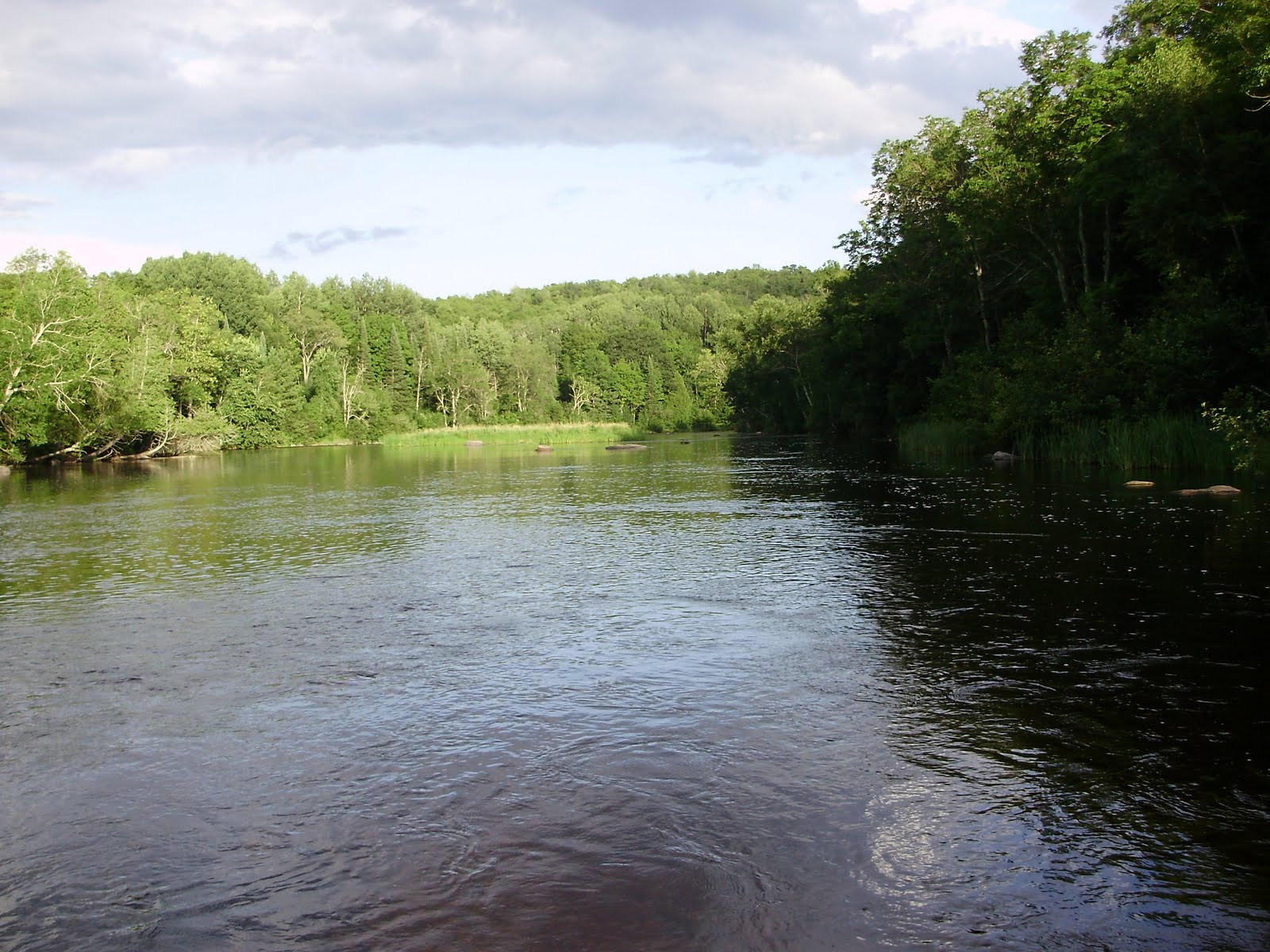
I’ve been fishing the Wolf River the last couple weeks. And the Smallmouth Bass action has been hot. The Wolf is historically known as trout water, the upper part at least north of the Menominee Reservation. Brown trout is the main target. But for me I’ve switched gears and got into hunting down big smallmouth bass on the Wolf. By big I mean 16-18 inches maybe 20”, they’re in there because I’ve caught them up to 18”, not overly that big compared to other areas of the state or even compared to the Largemouth. But these smallies or Bronzebacks as some call them put up one heck of a fight in the strong current of the Wolf, they make big Largemouth look like powder puffs when it comes to the battle. The smallmouth could probably whip their weight in wildcats, seriously they are a fighter but majorly overlooked on the Wolf.
video
A good example of a deep eddy around a boulder
video
My partner Volker landing a nice 16 incher

  I’ve been fishing the Wolf since the late 80’s mostly for Brown trout. But after hooking into a few big smallies they slowly got my attention. I know the Wolf pretty well from all the years of fishing it. And found the big smallies hang in the deeper eddys and holes. Fishing these spots you need to take caution on the Wolf. The current is strong and the deeper you wade the more chance of getting dumped and going for a swim.
video


  So what gear do you need for this type of fishing? Well first off, you can don chest waders and I do at times. But for me I throw on a pair of shorts and rubber boots. You’re gonna get wet fishing these guys so I look at it like go comfortably, chest waders are hot and when you fill them, it’s a pain. So I go light. I strap on a back pack for my tackle which is minimal, a bottle of mountain dew or 2, my camera, and my surgical looking forceps for removing hooks. My camera is in a Ziploc bag as well as my cell phone, never know when you may need to call for help.

  For a rod, use what you want in the med. to ultra light using atleast 6#-8# test line. My buddy is using that red Cajun line in #4 test and hasn’t broke off yet, tough stuff. My favorite line is Royal Bonyl but it’s not made anymore, at least I can’t find it. So I use Trilene Max, and it has been performing fine, I was using Berkley Iron Silk, but can’t seem to find that either anymore, at least it’s not carried around here anyway.

  For lures I’ve been using spinners in the size 2 range or topwaters in the 1/8 oz range. The Rapala Skitter pop is doing a dandy job smacking the bass as is a shallow running rapala. The spinners were doing fine early on but the topwater lures have been explosive, getting hits that send your lure 2 feet or so, or the explosive smash of a big smallie or sometimes the subtle suck it under. Either way it’s been fun. Fishing deep rapids with large eddy’s or stretches of deep water with weed growth along the edges seems to be the ticket, these spots provide a good food source with crayfish thick and abundant in the slow weedy stretches and in the eddy’s they prey on other fish like chubs or even trout. I caught a 17” that had a small brown trout in its belly. I usually catch and release but will keep a few for the frying pan, they are good to eat with a tighter grain meat than the largemouth, and ones feeding heavy on crayfish have a taste of crab which I like. A local lake I fish the smallmouth taste like snow crab to me, their also bigger in that lake, but the action and fight on the river is more exciting and challenging, fighting around logs rocks is tough on your line and you just never know when you’ll here that dreadful snap of your line being shredded in an instant.
 A nice stringer full
 Deeper slow water
20" from an area lake
video
 Sometimes the action is so fierce you get 2 on one lure,lol.

 You need to take caution wading in the Wolf, the rocks, boulders, trees submerged under the surface are a challenging but treacherous obstacles to be aware of. Many times I’ve taken a header into the strong current of the Wolf, and she is not forgiving. When this happens always get yourself positioned facing and your head upstream while trying to get up it’ll protect your head from smashing a rock and you can actually swim it out if you face upstream. I’ve recently twice now this past week took swims, once losing my small tackle box and once yesterday smashing my knee into a boulder. So pay extra attention to where you’re walking, and if you’re going to fish till dark carry a waterproof flashlight to shine the bottom as you walk, walking blind in the river is dangerous stuff.
Some areas along the Wolf are walkable from shore where you can take your son or daughter. As you can see in the background how rough the Wolf can be.

  A bonus to fishing towards evening is the chance at catching a nice snapping turtle, their good to eat and not hard to catch. When you see one swimming, just grab it by the tail and hoist it up, but keep it at arm’s length to keep from getting bit. I’ve caught 3 so far with shells measuring at 15”, that’s a good size turtle. I usually carry a plastic burlap bag in my backpack for these guys. Just put them in the sack and tie it shut with a piece of rope and drag it along on my way back to my truck, then kill it at home, then clean it. I guess I’ll have to write up on how to kill and clean a turtle. Their excellent table fare.


  Well any way I hope you enjoyed the pics and vids, and give the Smallmouth a shot if your ever on the Wolf you won’t be disappointed.