Thursday, June 16, 2011
Making a trappers dirthole punch
Been busy with alot of things lately and my latest project is making 30 dirthole punches for a Youth Trappers Camp here in WI. It teaches trapping and each kid gets his own equipment to get started, from lures to traps. My job the last 2 years is donating my time making a dirthole punch and trap stakes. So I decided to do a little video on how to make one. To use one you just pound it in the ground, twist and pull out and you have a hole to put bait or lure down for your intended target animal.Hope you enjoy.


Thursday, May 26, 2011
Wednesday, May 18, 2011
Foremost Coyote Hunting: Basic Coyote Trapping Equipment
Foremost Coyote Hunting: Basic Coyote Trapping Equipment: "(getting started) By Duane Fronek Well to get started trapping coyotes I guess is to know what equipment to use and how to use them. Con..."
Foremost Coyote Hunting: So, you want to trap coyotes?
Foremost Coyote Hunting: So, you want to trap coyotes?: "With the ever growing coyote population, predator calling has become a popular sport and useful tool in coyote control in some areas. But is..."
Monday, May 16, 2011
“Trap Modification from the bottom up”
By Duane Fronek
Trap modifications have been around for some time. But they have gained trapper awareness or acceptance in the last decade or so. With change comes questions. Some frequently asked are “What do they really do? Or “how do you do modify this or that?” And probably the most common, “are they worth it and will this work?”.
Well, I'm here to tell you they do work and are worth it, they help prolong your trap’s life just by the fact your basically reinforcing it's components, base plates keep trap bases from bowing from hard fight animals or just plain use over time or even utilizing four-coiling systems. Laminating the trap jaws strengthens them and helps keeping hard fighting critters like coyotes from popping the jaws out, they also provide a wider jaw surface or face which prevents paw damage. They’re easier on the animals that are trapped and can withstand the extreme abuse the animals can dish out; and stubborn trappers for that matter. This article is going to address the basics of modifying your traps from the bottom up to better understand the basic techniques to properly modify traps..
First, it’s critical to start with a clean trap. New traps don’t need much cleaning just basically a good washing with a power washer at a local carwash. Used traps on the other hand, are a different story. Steels enemy…rust can be removed easily by soaking in vinegar a couple days then hosed off with a garden hose. Traps with wax or speed dips need to be cleaned up as well. Wax can be taken off by boiling in Sani-flush or Dawn dish soap then hosed down. The speed dipped ones can be done according to the manufacturers suggestions. Usually, an over night soak in a bucket of lantern fuel sometimes called “white gas” does the trick. A wire brush might be needed to further clean off the dip. Then hose down.
After your traps are cleaned up you need to break the trap down by removing chain and the springs. To remove the factory chain you can either open up the j- hook with a screw driver or just cut it off with a bolt cutter; I prefer the bolt cutter. I won‘t be re-using the j- hook anyway I feel it just weakens them. Removing the springs helps you work on the trap easily and prevents you from accidentally striking an arc on the springs while welding. This can weaken or completely ruin your springs. It also helps for when welding close to the D-ring because the bottom of the lever ear won’t be in the way.
To remove the springs, I just take a screw driver and get behind spring arm that sits behind the lever and pry it out by sliding your screw driver behind the spring arm. Next, by prying away from the lever the arm will be released. Keep your fingers out of the inside of the jaws when doing this or you’ll get smacked by the spring when it snaps out of the lever.


Now that you have the trap broken down, your ready to start modifying. For welding, I use a 110v wire feed welder with gas, you can use flux core but it spatters a bit more but does the job none the less just not as pretty. First, we’ll start with the base plate and D- ring. You can get baseplates from most any reputable trap supply like J.C. Conners or Minnesota Trapline products. Or you can make your own but that’s a whole different subject. Base plates come with their own D- ring some may have a ring already attached to the baseplate, It all depends on what you would prefer.
Now that you have your base plates, take your trap and secure it in a vise upside down. I usually clamp onto the frame end or jaw post. I position it so the jaw post is clamped in the middle of the vise and the rest of the frame rests on the jaws of the vise. Before I add the baseplate on some traps like Northwoods or Bridgers I’ll grind off the rivets that stick out on the bottom of the base at the cross frame. Completing this process helps prevent the D-ring from binding once the base plate is welded on giving it more clearance to move like it should. Once the trap is clamped securely to the vise it’s time to reinforce the cross frame. Make sure you ground your welder to the vise somewhere, you can even ground right on the trap but clamping it to the vise saves time. Once your grounded you can weld a bead where the cross frame meets, weld a bead along both sides. At this time, you can run a bead of weld along the pan post. This helps secure it from abuse and possibly loosening down the road. Note this in the picture below..


Now you’re ready for the base plate. With your D- ring slipped over the base plate, lay the base plate on the base of the trap. Make sure it’s square along the sides, this is important because if it sits over the side one way or another you won’t be able to get your levers back on. The ends should be square with end of the trap as well. Once the base plate is in position you need to clamp it to keep it in place while welding. For this I recommend using two sets of small vise grips. Clamp just a little more than an inch from each end of the trap base. Each vise grip is clamped on opposite sides of each other to keep the base plate flat. Clamping along the same side raises the base plate slightly on the other side and often leaves a gap between the trap’s base and base plate. It should look similar to the picture below.

Once your base plate is secure you can run a weld bead along the ends of the base plate and base. Next, put a good spot weld on both sides of the hump in the base plate where the D- ring is located. You’ll have four spot welds here. So right now you have basically modified the bottom of the trap. After letting the trap cool for awhile you can proceed to modify the jaws. One word about cooling the trap after welding, just leave it cool at room temperature. Never dip the hot trap into water after welding; this will crystallize the weld and it will usually break.
Now let’s bring our attention to the trap jaws. Lamination strips for most brands of traps and sizes can be purchased through trap suppliers that were already mentioned or you can make your own. Again that‘s another subject. You can use flat bar stock, #9 wire or 3/16” or ¼” cold roll rod. I prefer the cold roll rod it’s just my personal preference but the method to add them to your trap jaws is basically the same.
Once the lamination strips have been obtained it’s time to get started. First clamp the trap in the vise by the base of the trap. Once the trap is secure, you can proceed to set up the jaws for welding. You’ll need a flat piece of steel or sheet metal to clamp between the jaws, I usually use a 1/8” piece of flat bar stock for square jawed traps and a ¼” piece if they are offset. For round jaws I use a piece of sheet metal or if their offset a piece of flat stock either 1/8” or ¼” in the offset. The thing with the round jaws is you need a piece between the jaws that’s just thick enough to keep them separated if the piece is too thick the top of the jaws wont be flush against the flat steel between the jaws and not allowing you to get the lamination strips even along the jaws. Now with the piece of steel between the jaws, I clamp everything together by using needle nose vise grips around the jaws. These are positioned just off center, being off center will allow room for welding at the center of the lamination strip. Also when your jaws are clamped like described it will hold your jaws up. Once this is accomplished it’s time to secure your lamination strips. Lay a lamination strip on top of the jaw and tight up against the flat piece of steel between the jaws. Now taking a small vise grip, clamp one end of the strip to the jaw. Be sure to keep the vice grip about an inch from the end of the strip to allow for welding. Now proceed and clamp the opposite end the same way. It’s very important to clamp this way instead of just using one vise grip in the middle somewhere because the heat from welding will make the lamination strip move causing you not to have your lamination strip flush with the jaw face. Now that you have your strip clamped securely your ready to weld. What I do is just hit a spot weld on each end to secure the strip even more. Then weld a bead on each end of the strip utilizing a ¼” bead to ½” bead is recommended. Once the ends are welded, run a weld at the center about an inch long. Now after that’s done your ready to go to the other side and repeat the process. This illustration shows how it’s set up for the jaw laminations as described. The springs were left on just for a demonstration..


Also at this time if you want to inside laminate your trap jaws as well, leave the flat bar stock clamped between the jaws and remove the trap from the vise. Then, flip the trap over and clamp the trap in the vise by the flat bar stock. Now clamp your lamination strips on the inside of the jaw as you did to the outside laminations. Be sure to keep them tight and flush up against the flat stock. Then weld as you did the outside laminations.

Now it’s time to reassemble the trap. Put the springs and pin back in there places making sure your spring pin is through the trap levers as well. To get the spring arms back into the slotted groove behind the levers take something like a piece of bent over brake line or a 3/16” or ¼” socket driver that looks like a screw driver. Now slide it over the spring arm and while holding the levers up with one hand pull the spring arm back. Use your other hand to get it behind the lever and slip the brake line or driver off and your spring arm will snap in. This picture illustrates how to do it.

After installing the springs you can replace your pan and do your pan adjustments. Add your swivels and chain to the D- ring, dye and wax and you’re ready to go. You’ll have a trap that looks similar to these depending on what type of trap you modify.


You’ll have a trap that will last you probably a lifetime and will take any abuse a critter can dish out. Also it will treat your catch gently by decreasing paw damage even on incidental catches. In this day and age improving the equipment we use is a responsibility we as trappers need to take on not just for treating our catch humanely, but to also show we as trappers are a viable and efficient wildlife management tool. But also show we are not some caveman using medieval equipment that maim like the Anti’s would like the public to believe.
This is how a modified trap treats the animal.


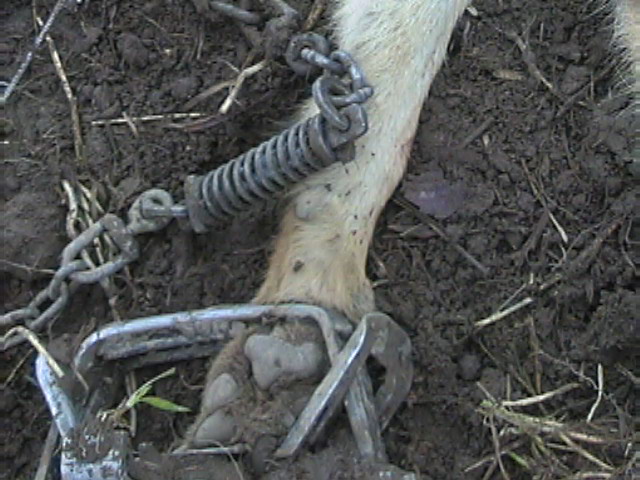
No chewing feet here. Just like a pair of hand-cuffs.
I hope this article answers questions to modifying your own traps. Good luck trapping.
Monday, April 25, 2011
Busy Spring so far
Spring is finally here, I think. Been cold, snowy, rainy. But it hasn't slowed the predators down. Still working on a coyote job where a family of coyotes setup camp in the middle of a game farm waiting for the annual fawn crop to drop. Unfortunately, they won't be there for the special occasion, for they had reservations made for them by yours truly and now are chasin' deer and bunnies in the great beyond. Still have the steel set for any intruders that may find there way there being that there is a vacancy open now. Young males tend to travel now seeking a suitable home that will tide them over till they find a mate of their own.
It's been interesting, I managed to catch a red fox twice in one week. First time he got caught by a front foot, the second time a week later he submitted a back foot to the set. Both times he was released unharmed. If I keep catching him I might just have to name him. I like red fox, well I like most animals, but the red fox is cool. These days their numbers are low around me. I use to trap a lot of them up until 1996 when mange ran through the fox population here. They never recovered their numbers as the coyotes moved in and took over. Now when I catch a red fox I usually turn him loose in hopes that maybe they'll come back like they once were.Skinning a red fox is a lot easier than a coyote any day.
Doing this kind of control work takes some skill and woods savvy.During fur trapping your basically taking the cream off the top and it really isn't that hard. But when you target 1 animal or a certain few, you need to read sign, and be able to detect even the subtle stuff. Sometimes these critters will quit using woods roads altogether where finding tracks is the easiest. You may walk deer trails looking for scat or tracks on top of deer tracks or a small mud spot. Ttrapping techniques are a little different, relying on more territorial lures or just plain coyote pee as compared to food type lures and baits. Coyotes are very defensive of their territory during this time of year, intruders are quickly persuaded to leave. The area they will usually defend is usually only 2-3 square miles. So trapping these problem critters requires getting in close to the denning site or at least inside their territorial boundary this time of year. Trapping techniques are subtle, usually a trap buried in front of a clump of grass and a shot of urine as if another came through marking territory. Sets like these tend to end the resident coyotes killing days. As with this couple, they were a veteran pair, being chased by a few trappers the past few years, but to no avail. So they were educated to the trapping world and highly pressured. When I came in, I set heavy but stayed away from the traditional stuff and went subtle and simple, no big flashy dirt hole sets which do attract coyotes, but these two seen it all. So I'd find where they were traveling and plant a trap just off to the side of tracks they left behind and give a shot of pee or just a small drop of gland lure from that of mink. Ole wiley comes trottin down the trail, he see's nothing out of the ordinary, then all of a sudden a faint whiff of a mink hits nose, he stops and immediately his nose is honing in on the smell with his feet in toe, and as he turns on the trail to get a better whiff of this new odor, his next foot fall lands on the pan of the trap and he's bagged, his mate fell for the same trick, but her nose picked up the scent of another coyote that left his calling card along the trail. Their nanny a 1 year old pup from last year fell for the same trick momma did on the same day. A pair of adult coyotes usually will have a female pup from the previous year hang around to help with puppy care duties.
Now that the trio were taken out, the challenge remains to keep another pair from setting up camp. So far it's been quiet, with just a red fox who was a slow learner and a bobcat that was released unharmed.
Tonight I get another call from a beef farmer with calves dropping right now and coyotes are starting to come in like flies. So will be checking that one out tomorrow. Seems to be a little bit of a surge in coyote numbers around here. The year before distemper or parvo had gone through here and killed most of the pups and the trapping season was slow with mostly older coyotes caught. But their making up for it. Most of the young of the year this past fall consisted of mostly females, if these females that made it through the season get bred, we could see another surge and fear we'll see mange to follow. I guess we'll have to wait and see. Got some beaver work coming up as well. So thought I'd get a blog in before I get busy with that the next few days as well.

The Alpha female

The helper female

The red fox who still runs free

The Alpha male

A Kodak moment with my little friend

She cheered up once I let her go.

A vulture that seems to be following me around for some reason.
Thursday, April 7, 2011
Fair Chase
By Duane Fronek
I see this little phrase come up from time to time. What I’m about to write might infuriate some and please others and leave others thinking about where they stand on this little phrase. My thoughts on the phrase “Fair Chase” in a nutshell is basically, has got to be the most dangerous word to outdoor men and women and our pursuits in the wild when it comes to hunting, trapping and fishing. The phrase in my opinion is probably the most responsible for hunting, trapping and fishing rights lost over the years, pitting one outdoorsmen and women against another. Simply put fair chase is basically not just a phrase but an attitude and a tool to justify ones way of doing things, while sacrificing those of another. We see it all the time when issues come up such as the use of cross bows, high fence, hunting with hounds, trapping and the list goes on. The animal rights groups love that little phrase, because they have it figured out, and know those two words are their meal ticket for pushing their agenda. Their agenda, banning all forms of hunting, trapping and fishing, period.
I’ve heard it said many times before, don’t know who the originator of it is but it goes something like this; “in order for a hunt to be fair chase, we would have to hunt with what we came into this world with, naked and our two bare hands.” And that would be true in my opinion. Animals survive with what they were born with, necessary to survive. Man on the other hand were born with a thinking brain, to solve problems to give us an edge. When it comes to hunting, we surely can’t run as fast as most animals, so man thought of ways to do the running for him, spears, bows, traps, guns etc. If we were to take a step back in time with our modern hunting equipment, we most likely would be worshipped on what we had to make our hunting more successful, that edge so to speak. Man has always used his most important weapon, his brain, when it comes to hunting, trapping and fishing. Because that’s our biggest weapon in order to survive and to equal out our physical short comings to the game we pursue.
I’ve heard so many arguments over the years on what was fair chase, things like running coons, cats or coyotes with hounds not being fair chase, or baiting is not a fair chase practice or high fence hunting isn’t real hunting, or trapping isn’t fair chase because the animal doesn’t have a running chance. To all that I say hogwash. Hunting with dogs is more than just turning dogs loose, there’s training, breeding and basically one’s way of life or way of doing things, they have a passion for it and they’ve figured a way to use man’s best friend to aid him in hunting, using the dogs as a tool. Baiting is just another form of hunting, no different in my opinion than placing out doe in heat or sitting on a corn field, your using the animals needs and instincts against them in order to gain an edge, same as just sitting on a ridge where you can see several yards and perched on the ridge with your trusty 300 mag. To reach out and touch one. It wouldn’t make much sense to sit there with a pistol or slug gun, no, we utilize the tools we have, to give us that edge. Now a deer walks up to within 40yds and you have the 300 mag in your lap are you gonna pass up the deer because he’s not 300 yds out, I don’t think so. Same with high fence, some say it’s not sporting or fair chase. Well think about this, a lot of high fence are 100’s and even 1000’s of acres, where the deer roam where ever they will in basically in the same settings as their wild counter parts, just better taken care of. there are quite a few hunters out there that don’t have the luxury of time on their side to enjoy the outdoors the way a lot of us do, their business men and women with busy schedules or locked in a city with no land they know of to hunt on or the time, but yet have a love and a passion to hunt just like the rest of us. I’ve heard it said trapping doesn’t give the animals a sporting chance, well most of that comes from those never doing it, just like I suspect with the other claims of why this or that isn’t fair chase. Trapping involves knowing your target well, well enough to put his foot on a pan or trigger no bigger than say 3”x 3” in order to get caught, you need to know their habits, what makes them tick just like pursuing any other thing like hunting or fishing.
So why condemn something or tactic another uses? Could be a number of reasons , jealousy, greed, or just plain stubbornness because that’s not how I do it. And each time we attack another’s legal way of doing things, we in essence are driving a nail in our own coffin for future use by the anti’s. Take for example your on the front lines in a war, and all the tall guys are getting killed. Everyone gets together and says, lets not use tall guys in this fight, it’ll eliminate anyone getting killed. So they do and go back into battle and now the medium height guys are getting waxed. So they have another meeting and decide, ok lets just use short guys, to prevent any further damage and fatalities. Now the enemy has the advantage of less troops in the ranks and basically over runs the troops and wins the battle. And in essence that’s what we are doing to ourselves when we start acting under the guise of fair chase. We essentially are sacrificing another’s way of doing things in order to preserve our own, but in reality we are destroying ourselves and our numbers in the ranks that allows us to be over run by the opposition..
We may not agree on everyone else’s way of hunting or pursuits, but know this, everyone of us that hunts, traps or fishes has a love and passion for what they do, just as much as the next guy or gal, even if his/her way is different than ours.. Ben Franklin once said; “We must all hang together, or assuredly we shall all hang separately.” No truer words have been spoken when this country first began, and feel those words hold true for the outdoorsmen/women of today.

Subscribe to:
Posts (Atom)